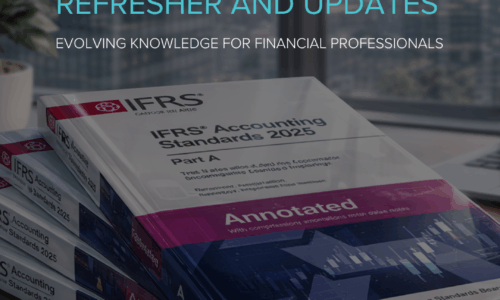
IFRS 9 & IFRS 17 (Focus on Banking & Insurance Sectors) provides a practical and industry-focused understanding of two of the most significant financial reporting standards affecting banks, insurers and financial services entities. The course explores how IFRS 9 Financial Instruments and IFRS 17 Insurance Contracts interact, and how they impact measurement, impairment, presentation and disclosure in regulated environments.
Banks and insurers face complex challenges in applying classification and measurement, expected credit loss (ECL) impairment, hedge accounting, insurance contract measurement models, and extensive disclosure requirements. In addition, the interaction between financial assets held by insurers and insurance contract liabilities under IFRS 17 requires careful alignment of accounting policies, modelling assumptions, governance and reporting processes.
This course equips participants with the knowledge to interpret and apply IFRS 9 and IFRS 17 in a way that supports compliance, improves reporting quality, and strengthens risk and performance communication to stakeholders.
TARGET COMPETENCIES
This IFRS Training comprehensive course will enable participants to appreciate and understand the following target competencies:
-
Understand the scope and objectives of IFRS 9 and IFRS 17
-
Apply IFRS 9 classification and measurement principles in banking and insurance contexts
-
Interpret and apply the IFRS 9 Expected Credit Loss (ECL) impairment model
-
Understand hedge accounting fundamentals and common banking applications
-
Explain IFRS 17 measurement models (GMM, PAA and VFA)
-
Identify key IFRS 17 components: fulfilment cash flows, risk adjustment and contractual service margin (CSM)
-
Understand presentation requirements and performance reporting under IFRS 17
-
Analyse interaction issues between IFRS 9 financial assets and IFRS 17 insurance liabilities
-
Interpret key disclosure requirements under IFRS 7 and IFRS 17
-
Strengthen governance, controls, data and modelling considerations for implementation and ongoing reporting
WHO SHOULD ATTEND?
This specialised course will benefit professionals involved in financial reporting, risk, actuarial, finance and compliance within banks, insurers and financial services organisations.
-
Accounting Professionals
-
Finance Directors
-
Chief Financial Officers
-
Risk Managers
-
Credit Risk Analysts
-
Treasury Professionals
-
Actuarial Professionals
-
Financial Reporting Managers
-
Internal Auditors
-
External Auditors
-
Analysts and Regulatory Reporting Teams
Organisations consider this course a valuable opportunity to upskill finance, risk and actuarial teams on the practical application and reporting impacts of IFRS 9 and IFRS 17 in banking and insurance sectors.
COURSE OUTLINE
Introduction and Industry Context
-
Overview of banking and insurance reporting challenges
-
Why IFRS 9 and IFRS 17 matter in regulated sectors
-
Key areas of judgement, data and modelling
IFRS 9 – Financial Instruments (Banking & Insurance Focus)
-
Classification and measurement: business models and SPPI test
-
Amortised cost, FVOCI and FVTPL in practice
-
Reclassification rules and common sector impacts
-
Expected Credit Loss (ECL) impairment model
-
Three-stage approach and SICR
-
Forward-looking information and overlays
-
-
Hedge accounting overview
-
Common hedging relationships in banks and insurers
-
-
IFRS 7 disclosures for banks and insurers
IFRS 17 – Insurance Contracts (Insurance Focus)
-
Scope and key definitions (insurance contracts vs investment contracts)
-
Contract boundary and level of aggregation
-
Measurement models:
-
General Measurement Model (GMM)
-
Premium Allocation Approach (PAA)
-
Variable Fee Approach (VFA)
-
-
Fulfilment cash flows and risk adjustment
-
Contractual Service Margin (CSM): recognition and release
-
Reinsurance contracts held
-
Presentation of insurance revenue, insurance service result and finance income/expense
-
IFRS 17 disclosure requirements
Interaction Between IFRS 9 and IFRS 17
-
Asset-liability alignment and accounting mismatches
-
OCI option and financial risk treatment under IFRS 17
-
Implications for product design, investment strategy and performance reporting
-
Governance, systems and controls across finance, risk and actuarial functions
Implementation, Governance and Audit Readiness
-
Data, modelling and systems considerations
-
Controls and documentation expectations
-
Common challenges and regulator/auditor focus areas
VENUE
Choice between In-house / External Venue / Live Online Classroom
Do you have more people interested in attending this course? Do you want to tailor it to meet your company’s exact requirements? We can deliver this course at your organisation’s premises, helping you reduce costs while improving ROI.
If you want a course at a location convenient to you or a completely customised learning solution, we can help. Our learning specialists guide you through the full process from consultation to evaluation to ensure maximum value from your training investment.
Course Features
- . 0
- Quiz 0
- Duration 5 days
- Skill level All levels
- Language English
- Students 0
- Assessments Yes